

 December 11, 2025Zoë Austin, BA (Hons), MA, PGCE
Before I put fingers to keys and begin writing this post, I scratch my scalp. I do this thousands of times a day: it is my primary stim. I don’t do it in public very often, as it’s not terribly sociably acceptable for middle-aged woman to be ferreting around in her hair like a flea-addled toddler, but once alone or in trusted company, my hand goes to my scalp.
We all stim. It’s short for ‘self-stimulate’. Any repeated or sustained action which creates a sensory experience within us is a stim. For neurotypical folks, this might be something as seemingly innocuous as biting one’s finger nails or lip skin, strumming fingernails on a hard surface, or touching our face over and over again. For us autistic and ADHD folks, however, stimming can include all of those things, but can also be bigger, bolder and definitely more noticeable. For this reason, it has become an unwanted and stigmatised behaviour, discouraged by society to the point that we mask what are useful actions, leading to deterioration in mental and physical well-being: the last thing we want for any of the children in our care.
Say the word ‘stimming’ and the classic images which spring to most (neurotypical) minds are of small boys flapping their hands, walking on tiptoe, or rocking. Whilst there is nothing at all wrong with any of these stims, they are only the tip of the iceberg. Stims may stimulate any of our senses (including vestibular/balance, interoception, or proprioception). So, they might involve repeatedly smelling a certain something, stroking beautifully soft fabrics, spinning in circles, eating spicy food, staring at shiny objects, lying on the ground… the list of possibilities is endless (and different for every individual)!
But why do people stim? Well, for several reasons. In the case of ADHD, along with sensory-seeking stims, we might fidget: repeatedly move in order to expel excess energy, get ready to leave a situation (think twitching legs when sitting through something dull), or just not be able to remain still for any length of time. We ADHDers also sometimes need part of our brain to be occupied with something like a repeated fidget in order to be able to focus on something else: without the fidgeting occupying one part of our attention, it would scatter and there would be no hope of, for example, a child being able to listen to a story. These cross over with autistic stims, which are likely to be useful in the following ways:
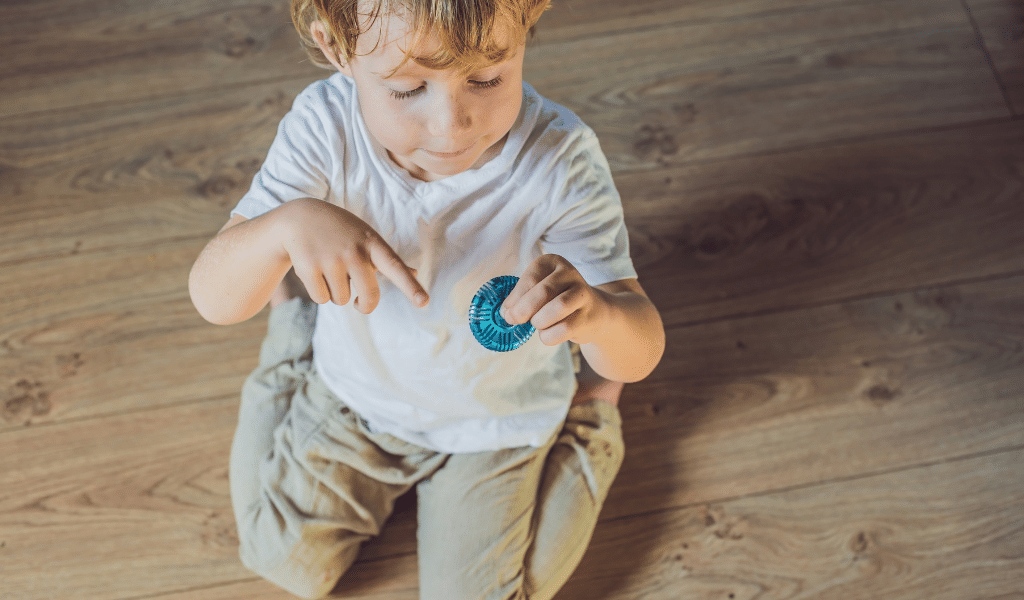
In all instances, children should never be stopped from stimming unless they are in danger of harming themselves or others. To stop a child from stimming is to deny them they bodily autonomy, to instill shame in them for behaviour which is only natural, and teach them that they have to appear “normal” in order to be accepted by and survive in the world around them. We know that mental health difficulties can begin in early childhood: this can be as much the case for neurodivergent children as for their neurotypical peers: damning behaviours which are part of their very essence will only lead to their self-image being one of “wrongness”.
Neuro-affirming, stim-supporting Early Years environments
With all of this in mind, here are some ideas of how you can support and celebrate the beautiful neurodivergent children in your setting by giving them the space and support to stim as much or as little as they need:

To conclude, we neurodivergents – both young and old – stim in our own ways and in different forms throughout our lives. We do so because we need to balance our over-stimulated brains, express our emotions, seek comfort and rest, or because we are hyper-sensitive to certain sensory stimuli, so experiencing the good stuff at full force can be incredible (see me, with 80s rock anthems blasting in my car at top volume), or perhaps hypo-sensitive to them (meaning we are lacking in that sense, so grab opportunities to experience it wherever we can. I am lacking in about 95% of a sense of smell – so if I ever get a waft of something beautiful, like honeysuckle on a summer breeze, you will find me with my nose in a flower for a very long time).
Whatever a child’s reason for stimming, they must never be denied the right to safely do so. Even at the young ages we meet them, children have the right to use their bodies as they see fit, to experience the world in the way that is best for them.

About the author
Zoë Austin is a freelance neurodivergent educator living in Cambridgeshire and working across East Anglia. She divides her time between providing group and individual music sessions, 1:1 tutoring for autistic/ADHD school-age children, mentoring autsitic/ADHD university students, and writing/presenting on the subjects of neurodiversity, child development, and music-making. Part of the Pen Green Schema Group, she contributed to the book Schemas in the Early Years (Routledge, 2022), and presented on ‘Schema theory and children’s emerging musicality’ at EECERA, 2023. Zoë uses her past experiences as a (Pen Green-trained) classroom teacher, Music Therapist and working in children’s social services to inform her position as a holistic practitioner, creating learning opportunities to meet the needs of the individual child as a whole person.
